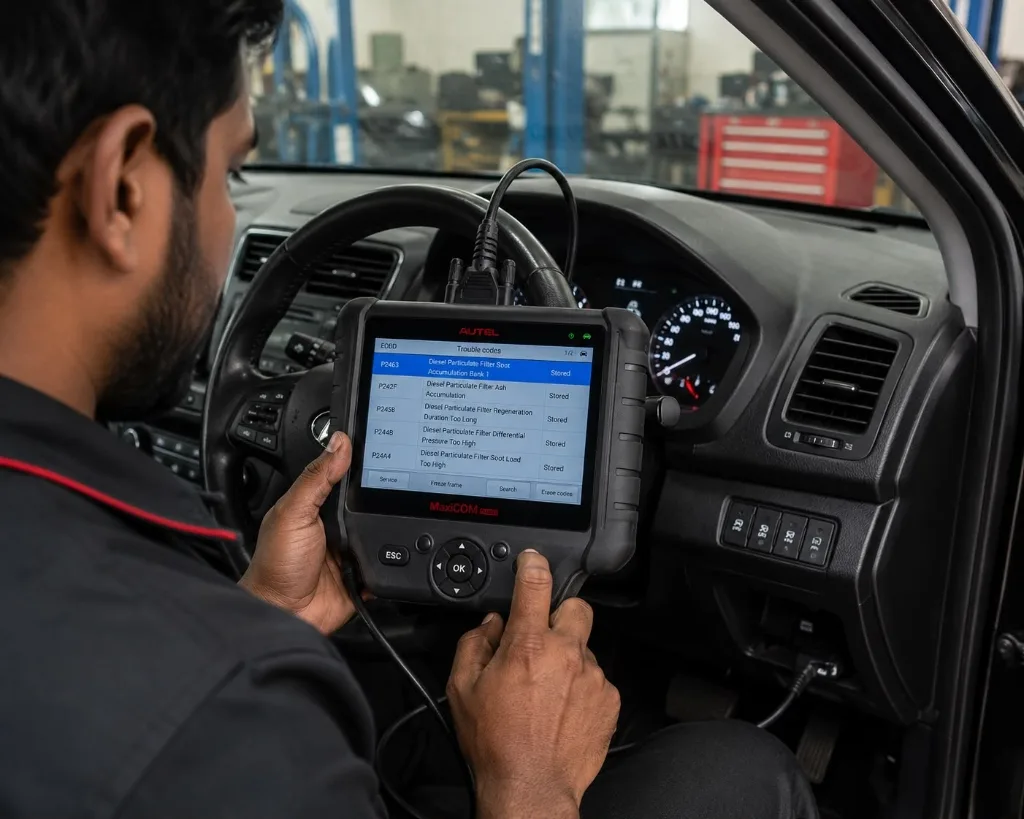
When the DPF or Check Engine warning light illuminates on your diesel vehicle dashboard, diagnostic OBD-II scanners report specific fault codes. Understanding these error codes is essential to determine whether your Diesel Particulate Filter can be fully restored to OEM performance through 5-stage scientific cleaning, or if underlying sensor or mechanical repairs are required first.
✅ Fault Codes Resolved by Professional DPF Restoration
The following fault codes indicate heavy soot, ash, or flow restriction within the filter channels. These issues are directly addressed and typically resolved by our professional hydro-pneumatic restoration and thermal regeneration process:
- ✅ P2463 – DPF Soot Accumulation: Triggered when soot loading exceeds normal passive and active regeneration limits. Restored completely after pneumatic flushing and soot removal.
- ✅ P242F – Excessive Ash Accumulation: Occurs due to non-combustible lubricant ash build-up over time. Resolvable if ash accumulation is within a restorable level and the DPF is not physically damaged.
- ✅ P2458 – DPF Regeneration Duration Too Long: Caused by severe exhaust flow restriction preventing successful regeneration cycles. Restored once normal flow dynamics are re-established.
- ✅ P24A4 – Excessive Soot Load: Indicates high soot volume inside the filter channels. Easily cleared after deep chemical soaking and flushing.
- ✅ P244B – DPF Differential Pressure Too High: Triggered by excessive pressure drop across the filter due to DPF blockage. Resolved once backpressure is normalized.
⚠️ Professional DPF Restoration May Not Resolve These Codes
Certain fault codes stem from physical substrate damage, catalyst degradation, sensor failures, or external exhaust leaks. DPF cleaning alone will not fix these issues without addressing the root cause:
- ❌ P2002 / P2003 – DPF Efficiency Below Threshold: May be caused by physical DPF damage, catalyst degradation, exhaust leaks, or sensor-related faults. DPF restoration alone may not resolve these codes.
- ❌ P244A – DPF Differential Pressure Too Low: Often caused by a faulty differential pressure sensor, blocked pressure pipes/hoses, or an internally damaged DPF.
- ❌ P2452 / P2453 / P2454 / P2455 – Differential Pressure Sensor Circuit Faults: Differential pressure sensor or wiring faults; DPF cleaning/restoration will not resolve these.
🔍 Important Technical Recommendation & Final Inspection
Note: Final diagnosis should always be confirmed using live diagnostic data, differential pressure testing, and a physical DPF inspection before recommending DPF restoration, repair, or replacement.
DPF restoration is recommended only for structurally serviceable DPFs. Any underlying engine, sensor, or exhaust system faults (such as faulty injectors or EGR valves) should be diagnosed and repaired to prevent repeat DPF blockage.